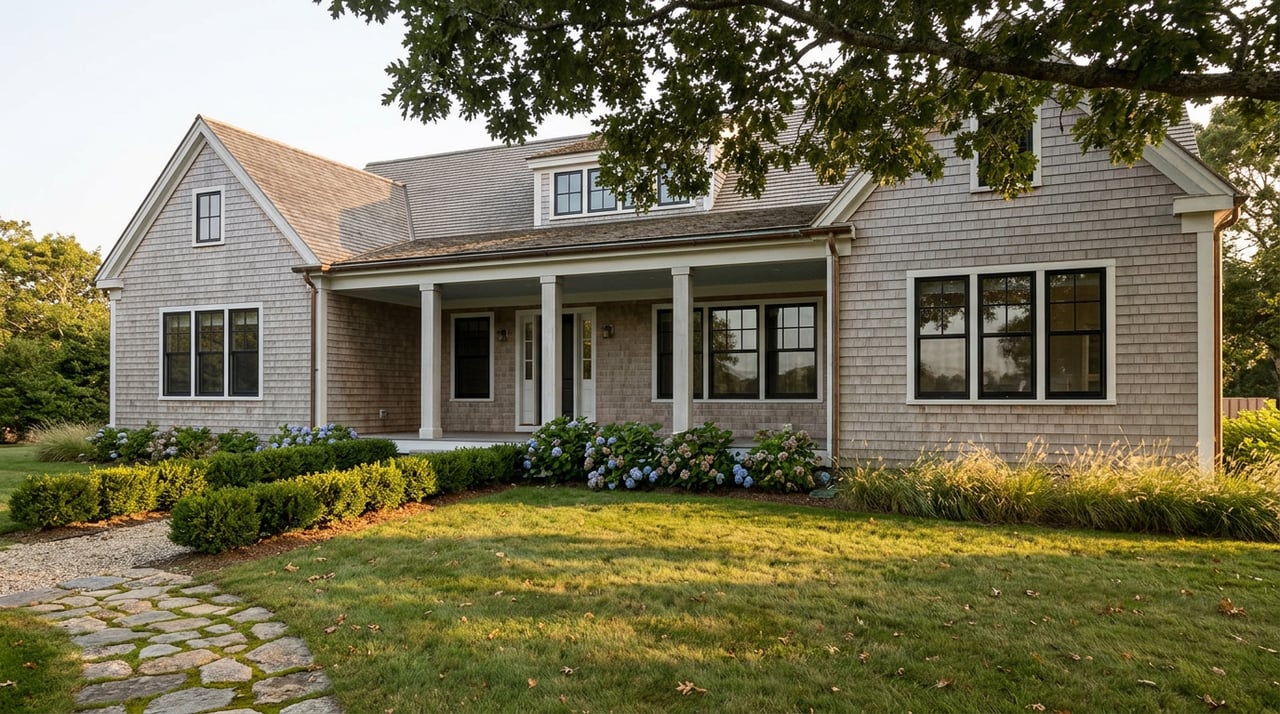
The State Exempted Martha's Vineyard From the New Septic Rules. Chilmark's Own Math Didn't.
September 24, 2026
September 24, 2026
If you have been reading up on Martha's Vineyard real estate before making an offer in Chilmark, you may have come across the news that the island dodged Massachusetts's biggest septic overhaul in a generation. That part is true. What the headline does not tell you is that a separate, older, and in some ways stricter system of nitrogen math still governs whether you can add a bedroom, build an accessory dwelling unit, or in some cases even close on a lot as configured. It has nothing to do with the state law you read about. It runs through the Martha's Vineyard Commission, and it is already showing up in real permitting fights.
The state's push started in 2021, when the Conservation Law Foundation sued the Department of Environmental Protection over Cape Cod's polluted estuaries. The draft regulations that followed in 2022 proposed a new category called "Nitrogen Sensitive Areas," and the initial version would have swept in watersheds across Martha's Vineyard and Nantucket alongside the Cape.
By the time the regulations were finalized in June 2023, that piece was gone. State officials dropped the plan to designate Vineyard and Nantucket watersheds as nitrogen sensitive after what regulators described as extensive public comment arguing the islands had not had the same runway as Cape towns to study and plan for the problem. The upshot, as the Vineyard Gazette reported at the time, is that the five-year mandate to upgrade septic systems to nitrogen-reducing technology never applied here the way it does on the Cape.
That is a real and useful fact. It is also not the whole story for a buyer looking at a specific parcel up-island.
Martha's Vineyard Commission has its own nitrogen modeling, applied lot by lot to properties that fall under a Development of Regional Impact review, the regional planning process that covers larger or previously subdivided parcels across the island, including a meaningful share of up-island Chilmark. That review predates the 2023 state rulemaking, survives it, and does not require a Nitrogen Sensitive Area designation to apply. The Commission has been tracking pond health and building its own loading limits for years through the Challenges and Solutions program, separate from anything MassDEP requires.
A letter filed with the Commission in January 2026 concerning a single-family property on Post Oak Road in Chilmark shows exactly how this plays out on the ground. The owner had already installed a Title 5 compliant septic system in 2021, sized for six bedrooms, as part of a remodel. The house itself has four bedrooms. That should have left room to spare. It did not.
According to the Commission's own modeling cited in the letter, the lot's estimated nitrogen load already sat at 6.06 kilograms per year against a desired threshold of 4.356 kilograms per year, before any accessory dwelling unit was added to the plan. The owner's response was to offer, at their own expense, an innovative and alternative nitrogen mitigation system paired with the proposed ADU, which the letter projected would bring the total load down to an estimated 3.6 kilograms per year, comfortably under the Commission's own guideline.
The letter's author put the environmental logic plainly, arguing the plan "improves existing conditions with respect to nitrogen and groundwater concerns." Whether or not the Commission ultimately agrees, the case makes the mechanism visible in a way that policy summaries do not. A property can carry a Title 5 certificate, pass its inspection, and still fail a nitrogen threshold that has nothing to do with the state mandate you read about.
There is a second layer worth knowing if you are counting on new state law to simplify this. The 2024 Affordable Homes Act amended Massachusetts zoning law to establish accessory dwelling units as a protected residential use that towns generally cannot prohibit outright. But the statute carves out an exception for compliance with applicable health and environmental standards. The Commission's nitrogen model is exactly that kind of standard. A law written to make ADUs easier to build up-island still runs into the same ceiling.
The nitrogen math is not bureaucratic for its own sake. Up-island's great ponds are the actual constraint, and several of them are already showing stress. Chilmark Pond has been categorized as impaired by the Commission's own water quality reviews, with a documented history of nitrogen loading high enough to trigger cyanobacteria advisories. According to island pond monitoring reported this year, the 2025 season brought some of the more troubling readings on record, with routine early-summer blooms at Chilmark Pond and one of the highest liver-toxin results the monitoring lab had recorded at Squibnocket Pond.
The Commission's own materials on the Chilmark Pond watershed put the mechanics in plain terms: on-site Title 5 systems handle pathogens well but do almost nothing for nitrogen, while innovative and alternative systems remove closer to 40 to 50 percent of it. About 90 percent of Vineyard homes rely on their own septic systems rather than a sewer connection, which is a large share of housing stock sitting on top of a small number of nitrogen-sensitive watersheds.
That is why the island has been running its own Up-Island Watershed Management Plan since 2021, covering Aquinnah, Chilmark, and West Tisbury specifically, apart from the wastewater plans Edgartown, Oak Bluffs, and Tisbury are pursuing down-island. If a Chilmark parcel sits within the watershed of Chilmark Pond, Squibnocket Pond, James Pond, or Menemsha Pond, it is operating inside that up-island framework, not the down-island municipal one, and it is a separate conversation from whatever the state decided in 2023.
The dollar figures matter because they rarely show up on a listing sheet. When Island officials were first modeling out the scale of the septic problem, Tisbury's water resources committee estimated in 2023 that innovative and alternative systems were running $30,000 to $50,000 per install, a cost borne largely by individual homeowners rather than the town.
| System type | What it removes | Who typically requires it |
|---|---|---|
| Standard Title 5 septic | Handles pathogens, minimal nitrogen reduction | Baseline code compliance, all towns |
| Innovative/Alternative (I/A) system | Roughly 40-50% of nitrogen | MVC nitrogen modeling on DRI-reviewed up-island parcels; some down-island watershed plans |
A Title 5 certificate at closing tells you the system meets the baseline health code. It does not tell you whether the Commission's separate nitrogen model has room left on that parcel for the addition you are planning, or whether the seller already used up that room with a prior remodel, the way the Post Oak Road owner did in 2021.
If you are looking at a property in Chilmark, particularly one within the watershed of Chilmark Pond, Squibnocket Pond, James Pond, or Menemsha Pond, a few questions are worth asking before you get to inspection contingencies:
Does this only affect waterfront property? No. The Commission's DRI review and nitrogen modeling apply to parcels within a pond's groundwater watershed, which can extend well inland from the shoreline itself.
If my Title 5 inspection passed at closing, am I in the clear? A passing Title 5 inspection confirms the system meets state health code. It says nothing about whether the Commission's separate nitrogen threshold has room for future construction on that lot.
Is this the same issue in Edgartown, Oak Bluffs, or Vineyard Haven? Those towns are pursuing their own Comprehensive Wastewater Management Plans at the municipal level, a different mechanism aimed at the same underlying problem. The specifics vary town by town, which is worth confirming for any pond-adjacent property regardless of which up-island or down-island town it sits in.
Nitrogen math is not the kind of thing a standard home inspection catches, and it rarely appears in a listing description. If you are evaluating a Chilmark property with renovation or ADU plans in mind, The Agency Martha's Vineyard can help you understand what a specific parcel's permitting history actually allows before you're under contract. Request a Local Consultation to talk through what a property's watershed status and DRI history mean for your plans.
Stay up to date on the latest real estate trends.





We offer real estate services with heart. As a locally owned agency, we provide trusted guidance and personalized attention to help you navigate the Martha's Vineyard market.

OFFICE 205 UPPER MAIN ST EDGARTOWN MA 02539 PO BOX 275 EDGARTOWN MA 02539